-
Marc Edmunds turns 50 and reaches 15% bodyfat
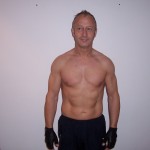
Having just turned 50, I am without question in the shape of my life. Dave has helped me achieve a physique which I did not believe would be possible. Having exercised my entire life, it ...
> Read more...
Lift Weight to Lose Weight
January 12, 2010 No CommentsHaving worked closely with many clients over the last few years, I have become increasingly aware that different people’s bodies react differently to the same exercises. For example, two people of the same age, roughly the same weight and fitness levels go about a fitness and diet programme they have read in a magazine. One loses a huge amount of weight, while the other loses very little or none. Why is this? Surely they are both taking in the same foods and burning the same calories, so why such a difference in result?
This article will give you the answers to this common scenario. You will also gain a much better understanding of how your body works and what you need to do to loose weight, tone up and burn body fat.
Here’s a question for you…
If Paula Radcliffe and Linford Christie were standing in front of you in their training kit, which one would you say had better performing muscles and why? Read and think about the question carefully!
You should be thinking along the lines of:
‘What does better performing mean?’
‘Linford is much stronger but Paula is much fitter?’
‘They are both fit but in totally different ways’
The answer is not straight forward. The facts are that both are runners and both are world champions. So why do their muscles look so different? It would be fair to say that if Linford Christie was to run a marathon, he wouldn’t challenge Paula’s 2 hours 15 minute record breaking time, equally, Paula’s 100 metre sprint wouldn’t be much on Linford’s 9.87 record breaker back in 1992.
The answer to this question is down to ‘muscle fibres types’. As you read on, you will learn why these two athletes play a vital role in understanding what your body needs to lose weight, improve strength or achieve any fitness goal.
Everyone has muscle fibres, they are long, thin, cylindrical cells which are arranged parallel to each other and grouped together in bunches. Your muscles are packed full of fibres, the diagram below gives you an idea of what they look like and how they are structured.
As you can see, the muscle fibres are deep within the muscle. This diagram above is taken from a small muscle in the forearm; the structure is the same for all your muscles, whether it is your bicep or your hamstring. You can also see that the muscle is attached to the tendon. You can’t see it from the diagram, but the tendon is attached to the bone. This rule applies for all the muscles of the body. Tendons attach muscles and bones.
There are three different types of muscles fibres:
| Type 1 | Type 2a | Type 2b |
Every person on the planet will have some of all three types of fibre. i.e. Within all your muscles, you will have some type 1’s, some type 2a’s and some type 2b’s. Decade’s worth of debate from sports scientists has concluded that both genetics and years of training are responsible for the percentage of fibre you have.
Let’s have a look at the differences between all three types of muscle fibre:
| Type 1 | Type 2a | Type 2b |
|
|
|
To summarise; someone with a high percentage of type 1 muscle fibres will be naturally good at aerobic type exercises like running and cycling. Someone with a higher percentage of type 2a and 2b fibres will be much better equipped to do explosive or strength type exercises.
So, because Paula has got lots of slow twitch fibres, she is able to run long distances and her body responds very well to aerobic training. Linford has lots of fast twitch fibres, so for him; he needs to do lots of strength and power work to achieve maximum results.
Here’s where the information above becomes relevant to you:
Hundreds of people have come to me in the past struggling to lose weight. Some have lost some weight on their own but others have lost none. Why? The first thing I will do when I take on a client is to advise them on their diet. With regards to exercise, I will always ask ‘What have you been doing to try and lose weight?’ The responses I hear most often are;
TABLE 1:
| Jogging for 30 minutes per day |
| 100 sit ups every day |
| 3 x aerobic classes per week |
| 45 minutes on the bike |
| Cardio |
| A bit more cardio |
| More cardio for good measure!!!!! |
I am going to show you why these exercises are unsuitable for a lot of people who are trying to lose weight…
Here’s where it gets really interesting…
All of the exercises in table 1 are only working your twitch muscle fibres. These are the ones Paula has got a lot of! So if you have lots of slow twitch muscle fibres like her, you will achieve great weight loss results by doing the exercises listed above, however, if you have predominantly fast twitch muscles, you will not benefit much or at all by doing these exercises!
So, looking at the original scenario of you and your friend both doing the same cardio based exercise programme, lets say you have predominantly fast twitch muscles and your friend has more slow twitch fibres. Your friend is much more likely to lose weight doing lots of cardiovascular exercise than you are!!!
I also happen to know that studies throughout the UK have shown that many people (men and women) have higher percentages of fast twitch fibres compared to slow. This sums up why people are struggling to lose weight by doing the ‘traditional weight loss exercises’ in table 1.
How do I know what % of muscle fibre I have?
It is impossible to tell exactly what % of muscle fibre you have without doing a biopsy of your muscle, however, based on exercises that have not worked for you in the past coupled with some trial and error with programmes it doesnÕt take me long to establish what percentage of weight and aerobic training you should be doing to obtain maximum weight loss!
With all my programmes, whether it is for men or women, I use weight training exercises. If you are struggling to lose weight by doing the exercises in table 1, I would be confident saying that you are not stimulating the majority of your muscle fibres by doing a tonne of aerobic exercise.
Wont weight training make me bulky?
Not if done correctly! I have successfully trained hundreds of men and women wanting to lose weight with weight training techniques. I am often faced with the statement ÔI donÕt want to do weights because I donÕt want to bulk up!Õ It is highly likely that the reason you have not lost any weight is that you are not exercising your fast twitch fibres i.e. weight training and circuit training. Doing weights comes with a fairly terrible reputation I know, images of big bulky men shunting unnecessary amounts of weight around the gym making farm like noises!
The truth is that, I use weight training exercises with all of my male and female weight loss clients and every one of them has lost weight. When I use the phrase weight training, I don’t mean repetitions of 25 with 2 kilo dumbbells! I mean repetitions of 1 to 8 with heavier weights!
What are the weight loss benefits to weight training?
You improve the strength of your metabolism! (Remember your muscles play a huge role in the process of burning body fat, by building up strength, you greatly improve your body’s ability to burn body fat. This doesn’t mean you have to have great big bulging muscles, it means that you need to spend some of your exercise programme focussing on weights.
You can work all three muscle fibres types in your body. Ultimately, in your weekly exercise routine, you need to work all of your muscles fibres by doing, aerobic exercise and weight training. As mentioned earlier in the article, most people only focus on the aerobic side of things, missing out the strength aspect.
If you have more fast twitch than slow twitch fibres in your body, you will stimulate more muscles within your body thus getting a much better weight loss result.
Particularly for the ladies reading, testosterone is required to build muscle. This is a hormone that you have not got much of, which is why doing 1 or 2 weight training sessions per week will not bulk you up, quite the opposite in fact! More likely is that you will improve your bodies’ metabolism which will allow you to burn body fat and drop a dress size!
Weight training also improves bone density (which often depletes as you get older)
In conclusion, it is absolutely essential that you work all the muscle fibres in your body by mixing up your exercise
Related content: